Grbl Controller + Silicon Circuits. Compact android mobile application for grbl powered cnc machines. GCodePrintr - The 3D Print App. 3D printing from your Android device. Control your Reprap,Printrbot,Prusa. More by PanmaneeCNC. GRBL Controller: 6 Axis. GRBL 1.1 PINOUTS GRBL 1.1 has all of the following output provided for operating the CNC machine or Laser machine. All of these signals are routed through the GRBL shield to the proper places for the stepper drivers and output connectors. The GRBL Shield goes on top of the Arduino Uno. It is designed to work with GRBL 0.9 to 1.1f.
- Grbl Controller Software Download For Mac
- Grbl 3018 Cnc Software Downloads
- Installing Grbl Control Software
- Sainsmart Cnc 3018 Software
- Free 3018 Cnc Software Downloads
- Grbl Candle In Window 10
I have Purchased a 3018Pro from Bangood, it worked ok for a while then it stopped responding
on all the Axes, I could only switch on the Spindle. Thinking this was perhaps a fault on the motherboard I ordered a replacement. While waiting for the replacement board the machine started to respond again after installing all the software onto a New/old desktop PC.
Then two days ago it stopped responding again as before with only the spindle powering up.
The new motherboard arrived today so I installed that. No response at all, the originall board still gave me spindle control. I have reinstalled the drivers and all the other software etc that is supplied through the links on banggood site (Several times) with no success.
What am I doing wrong? I can't believe all the Stepper motors have gone wrong at the same time. I don't Know what an ardwino ?? is other than it is some sort of mother board. I enclose photo of the old and new boards. I hope someone Can help me please.
Thank you Dev
My machine (basically this build: https://www.thingiverse.com/thing:1514145) has GRBL 0.9 : https://github.com/grbl/grbl/wiki/Configuring-Grbl-v0.9The documents for newer version are up there too, obviously. It would definitely be good to get v1.1 working in order to learn the process of getting it on a fresh Arduino board. I'll outline the process of how to do that in the section below this one and fill in the details as I get around to figuring them out. Here's what I do know for sure though...
Sending GCode to the Machine
You can use any number of GUIs but the premise is always the same.Once the firmware is on your board, connect it via USB, power it on, and search in your /dev/ directory for your Arduino (type that into Terminal and start typing 'tty' and then hit Tab until something shows up). If you have the Arduino software, use the drop down menus to identify an address like /dev/ttyusb#### or /dev/wchusbserial####The numbers will be unique to your computer. Take note of these.If you're using the Arduino software, connect to the chip through there and open up the Serial Monitor. You can start sending GCode right there.You can also follow examples on GRBL's github source to see .ino files to upload via the Arduino software that run your GCode.
TO USE PYTHON
Get the dependency that allows python to send and receive information over your USB ports.git clone https://github.com/pyserial/pyserial.gitcd pyserial && python setup.py install
(Alternatively, pip install pyserial)
You might need a driver to make sure your computer can communicate with your Arduino.
Chinese knock-offs sometimes don't play nice with these. Use http://www.wch.cn/download/CH341SER_MAC_ZIP.html for the Nano, for example. Google around until your device is listed in /dev/.
Authentic drivers are found at http://www.ftdichip.com/Drivers/VCP.htm
Copy this to a .py file (source: https://github.com/grbl/grbl/blob/master/doc/script/simple_stream.py )

Grbl Controller Software Download For Mac
Name this file streamGcode.py (or whatever)Create a new file named grbl.gcode and put your code in there.Now you can just run python streamGcode.py
You can also get a sense of what is going on in the python file above and stream GCode commands one-by-one through Python using IPython but at that point, I suggest looking up how to send/receive over the Serial port directly through command-line tools.
TODO Use sys package and create an alias so that you can run a gcode file located anywhere on your computer (to run the above, you would have to be in the same directory as the two files). Throw those edits and instructions up in this tutorial, share it with others.
I think this is how they expect the wiring to be by default: https://github.com/grbl/grbl/wiki/Connecting-Grbl
Step 1 - Clone the GRBL directory
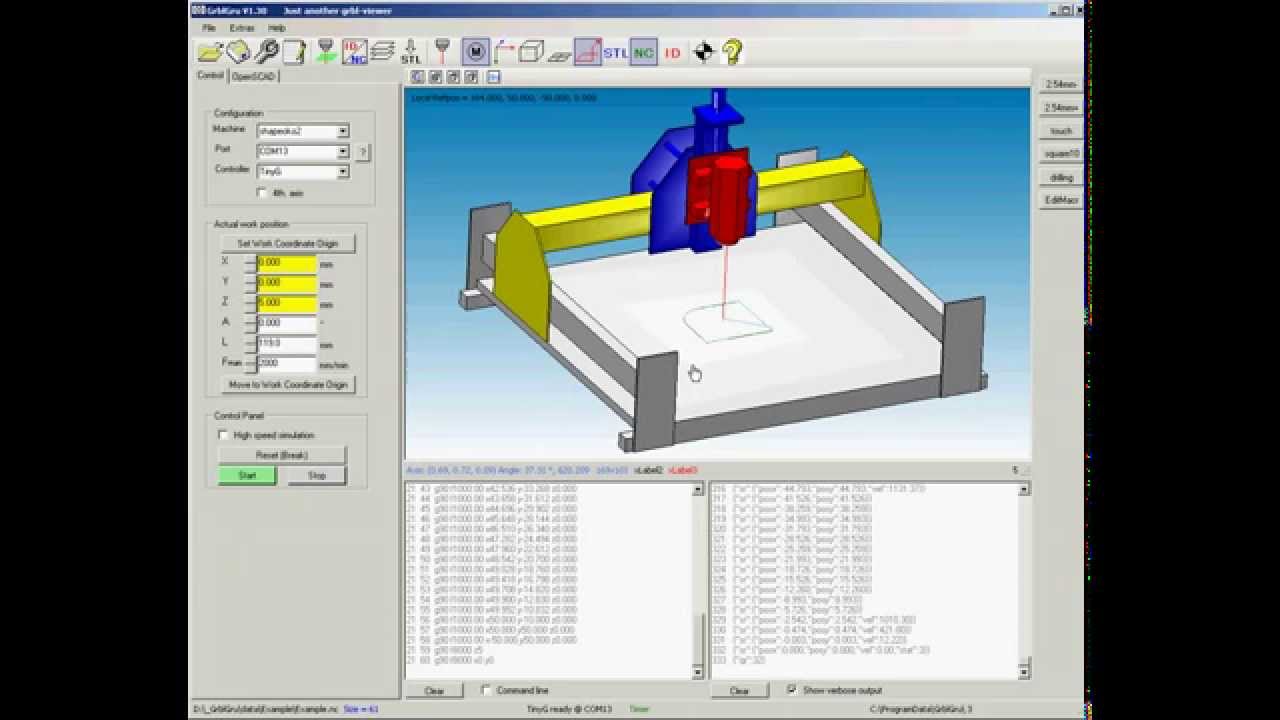
git clone https://github.com/grbl/grbl.git
Step 2 - Configure for your hardware.
TODO This is the bulk of the work. Go ahead and open config.h in the /grbl subdirectory and start editing it according to the custom thing you just built. The ports you wired need to be detailed here. I'm not sure what the default configuration is, but it's Cartesian, not CoreXY.
Grbl 3018 Cnc Software Downloads
Step 3 - Configure Paths
DO NOTE THAT THE PATHS MAY BE QUITE DIFFERENT ON YOUR MACHINE.
Add all those AVR compilers to your computer's
$PATH.TODO How to find the compilers on your computer. Mine were in/Arduino.app/Contents/Java/hardware/tools/avr/binSo adding them to my path would look likeecho 'export PATH='Arduino.app/Contents/Java/hardware/tools/avr/bin:$PATH' >> ~/.bash_add'(note the colon separating the path)Add $DEVPATH to
.bash_aliasesor.bashrc(LINUX) or.bash_profile(OSX) ... or a new file~/.bash_addwhere we'll temporarily store these since we only need them for this.
There are a few ways to do this, including editing the aforementioned files in the text-editor of your choice.From the command line, this looks likeecho 'export DEVPATH='/dev/tty.usbmodem1411' >> ~/.bash_add
Add
$AVRPATHas well.echo 'export AVRPATH='~/Downloads/Arduino.app/Contents/Java/hardware/tools/avr/bin' >> ~/.bash_addWrap UpRun
source ~/.bash_addto make Terminal aware of where all the software we'll need to use is located.You can add the above code snippet to your~/.bashrcfile (or equivalent) if you plan to recompile in the future, or just run it each time you want to.
Step 4 - Compile GRBL
This creates a hex file that we then need to flash to the Arduino
For ease, we now add $GRBLHEX to our .bashrc file as well.echo 'export GRBLHEX='/Users/Imogen/Packages/grbl-1.1f.20170801/grbl.hex' >> ~/.bash_custom

Once all the paths and configurations are set, runmake cleanmakein the top-level directory of the GRBL version you cloned (a folder named grbl-1.1f.20170801 or something like that ). Running ls now should reveal the grbl.hex file that you're going to flash.Go to https://github.com/grbl/grbl/wiki/Compiling-Grbl if you want details for Windows or more information in general. It has instructions for flashing right from Arduino, as well as telling you where to find some examples.
Step 5 - Flash your ArduinoMy fake Arduino nano wasn't being recognized by my computer.I downloaded http://sparks.gogo.co.nz/assets/_site_/downloads/CH34x_Install_MAC_10_9_AND_ABOVE.zip and installed it.
Installing Grbl Control Software
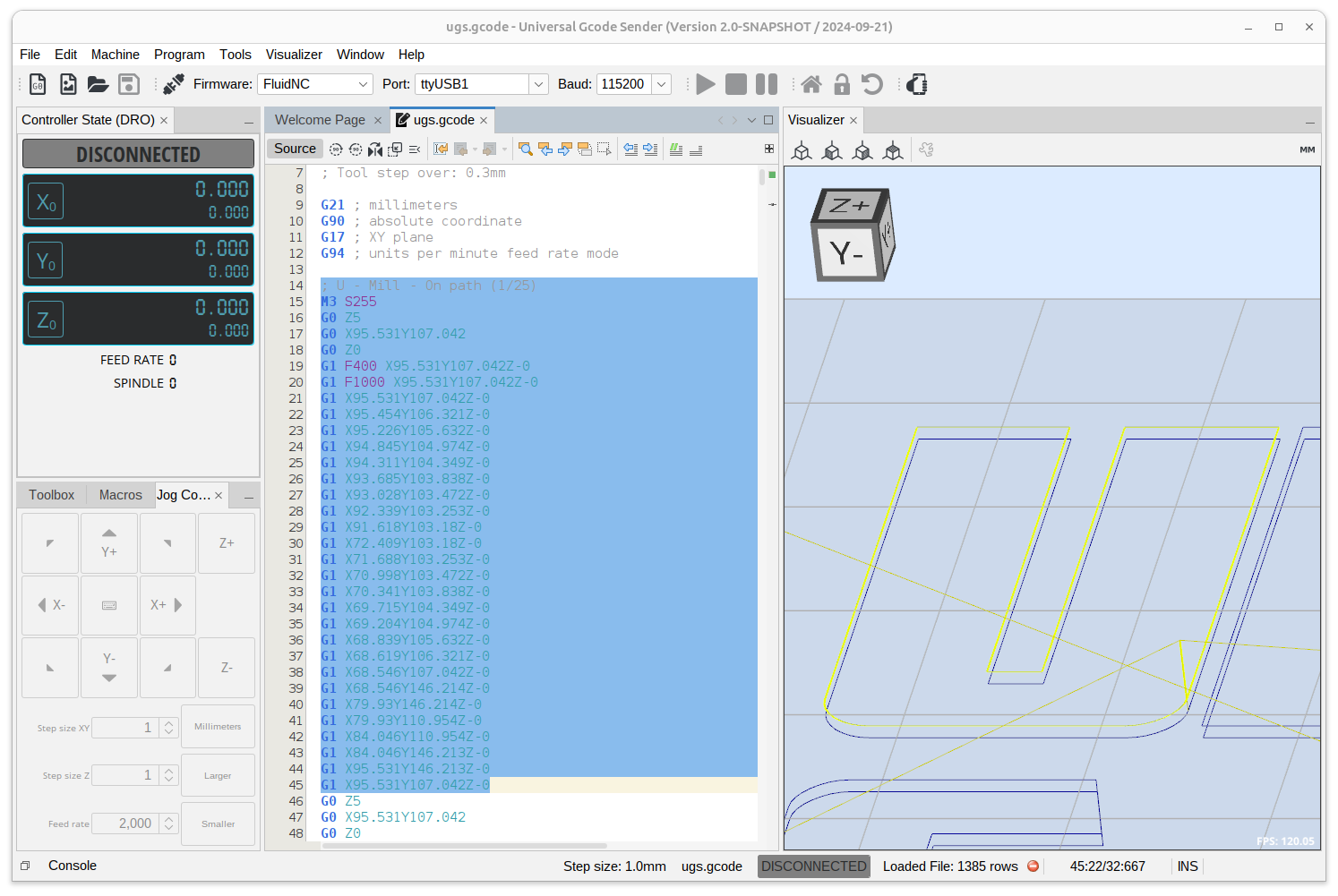
Then run
- For v1.+ on the Uno:
$AVRPATH/bin/avrdude -C$AVRPATH/etc/avrdude.conf -pm328p -carduino -P$DEVPATH -D -Uflash:w:$GRBLHEX - For v1.+ on the Duemilanove/Nano:
$AVRPATH/bin/avrdude -C$AVRPATH/etc/avrdude.conf -pm328p -carduino -P$DEVPATH -b57600 -D -Uflash:w:$GRBLHEX
Sainsmart Cnc 3018 Software
_More info, including older versions:https://github.com/grbl/grbl/wiki/Flashing-Grbl-to-an-Arduino
Free 3018 Cnc Software Downloads
General GRBL Usefulnesshttps://github.com/grbl/grbl/wiki/Interfacing-with-Grbl
Grbl Candle In Window 10
I think this is how they expect the wiring to be by default: https://github.com/grbl/grbl/wiki/Connecting-Grbl